How to Upload Csv Files to Python Anywher
Introduction to Python Import CSV
In this commodity, we will see CSV is elaborated equally comma-separated-values which is used to shop tabular information or spreadsheet file format, which uses comma as delimiter or separator, and such files are known as CSV files. In Python, to parse or work with such CSV files, we need to import the CSV module, an inbuilt module. To do this, we need to utilize the "import" keyword before "csv" to support CSV files or to parse CSV files in python. This csv module in Python is used to read or write or handle CSV files; to read or write such files, we need to loop through the CSV file rows.
Working of CSV Module in Python
In this article, we will see how to import the csv module in Python. In Python, csv is an inbuilt module used to support CSV files, such equally reading CSV files. Therefore to extract data from a CSV file, nosotros have to loop through rows, and we as well have to utilize split methods to excerpt information from each column which are separated past commas.
Now allow us encounter how to import the csv module.
Import CSV This statement is used for importing a csv module that is used for parsing tabular like data structure such as data in excel format, and these files are saved in .csv extension; this csv modules provide diverse classes for reading and writing data to CSV files. Now we will see various csv module functions and classes in the below section.
Examples to Implement Python Import CSV
Below are the examples of Python Import CSV:
Instance #1 – Reading CSV File using CSV Module Function as csv.reader()
This function is used to extract data from CSV files to read and print the output screen data. To do this, we need to create a reader object; then, the function will read each line of the CSV file and brand the list of columns and print it. We tin can read CSV files that are separated from any other delimiter other than comma-separated files.
Now will encounter how to read CSV file and is demonstrated in the below case:
Code:
import csv print("Program to demonstrate csv.reader() function:") impress("\north") c = open('company.csv','r') print("The csv file is opened for reading:") print("\northward") o = csv.reader(c) print("The contents of the above file is as follows:") for r in o: print (r) c.close() Output:
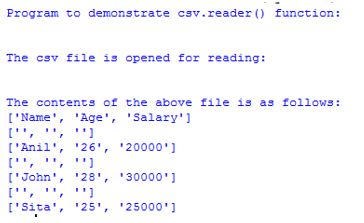
Caption: In the in a higher place program, we tin can see nosotros are reading file company.csv, which is already present in the electric current directory where the python software is present using an open up() function with read style 'r'. and the output displays the content of the file. This part gives No such file or directory as an error message if the file does not be.
Case #2 – Writing to the File using csv.writer()
This role is used to write the data to the file. This function can also be used to create a new file and open it in the write mode 'w'. Let usa demonstrate this function in the below example.
Code:
import csv print("Programme to demonstrate csv.writer() office") print("\northward") p_details =[('course','fees','place'),('Python',22000,'Pune'),('Android',11000,'Assam'),('Java',30000,'Delhi')] c = open('programs.csv','w') impress("File is opened for writing:") o = csv.writer(c) for p in p_details: o.writerow(p) c.close() Output:

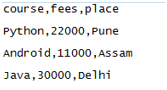
Explanation: In the above plan, nosotros can see we are writing details of programming courses, and we have opened a file named 'programs.csv' in write fashion 'w', which commencement creates a file, and so the details are written to the file. And in the output screen, we tin see information technology will print saying the file is opened for writing, and when we open the file, nosotros tin run across it in CSV format as shown in the in a higher place screenshot, where each data is written in separate columns and row. Note that CSV uses excel equally the default output to display the CSV file.
Nosotros will now see classes provided by the Python csv module for reading from and writing to a CSV file. DictReader and DictWriter are like to reader and writer functions every bit in the above section. Simply these classes use lexicon objects to read and write CSV files. At present will meet these classes in the below section.
Example #iii – DictReader
This class uses a dictionary object which is created for mapping the data to read information technology to the dictionary whose key is given by field names, but if the keys are non defined or declared, so by default, it will accept beginning row information as keys of the lexicon. Let the states demonstrate in the below example.
Code:
import csv print("Program to demonstrate DictReader() class") print("\north") with open('visitor.csv') as c: r = csv.DictReader(c) for row in r: print(row['Name'], row['Age']) Output:
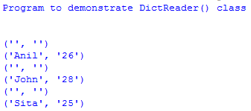
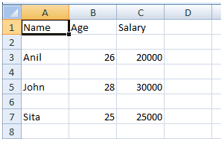
Caption: In the to a higher place program, we can see that we are using DictReader() function, which will read the file company.csv, and this will impress just those which keys are specified, such as "Name" and "Age" are the keys of the lexicon which is a company.csv file content. And then in the above screenshot of output, just the contents of "Proper noun" and "age" are displayed.
Example #4 – DictWriter
This grade is too similar to the writer() function. In this class, this likewise specifies the keys of the dictionary through "fieldnames" every bit these keys are optional in the in a higher place DictReader, only keys are must be specified to avert ambiguity when writing the information to the CSV file.
Let us demonstrate in the below example.
Code:
import csv print("Program to demonstarte DictWriter() class") impress("\n") with open('Game.csv', 'w') as file: columnnames = ['Game_name', 'No_of_players'] writer = csv.DictWriter(file, fieldnames=columnnames) author.writeheader() writer.writerow({'Game_name': 'Cricket', 'No_of_players': 12}) writer.writerow({'Game_name': 'Football', 'No_of_players': 11}) writer.writerow({'Game_name': 'Hockey', 'No_of_players': 11}) Output:

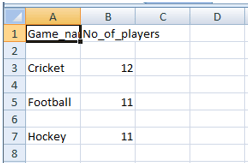
Explanation: In the higher up program, nosotros can encounter nosotros take created a new file "Game.csv" in write style "west" by using an open() function, and then we use DictWriter() to write the information to the file, and here we mention the cavalcade names as field names which are the keys for the dictionary created. In the higher up output, we tin can see how the file is created and the data is written to information technology.
Determination
This article concludes that the CSV module in Python is used to work with CSV(comma separated values) files. CSV modules are as well used in many applications in the data science subjects using the pandas concept in Python. This commodity saw how to read from and write to CSV files using this csv module. In this, we also saw a few CSV functions such as reader() and writer() functions and classes such as DictReader() and DictWriter(), which are created every bit dictionaries forth with keys as field names.
Recommended Articles
This is a guide to Python Import CSV. Hither we talk over a cursory overview of Python Import CSV and its Examples along with its Code Implementation. You can also become through our other suggested articles to learn more –
- Advantages of Programming in Python
- What is Recursive Office in Python?
- Introduction to Python Range Function
- Top seven Methods of Python Set Part
flemingfadonsuded.blogspot.com
Source: https://www.educba.com/python-import-csv/
0 Response to "How to Upload Csv Files to Python Anywher"
Post a Comment